
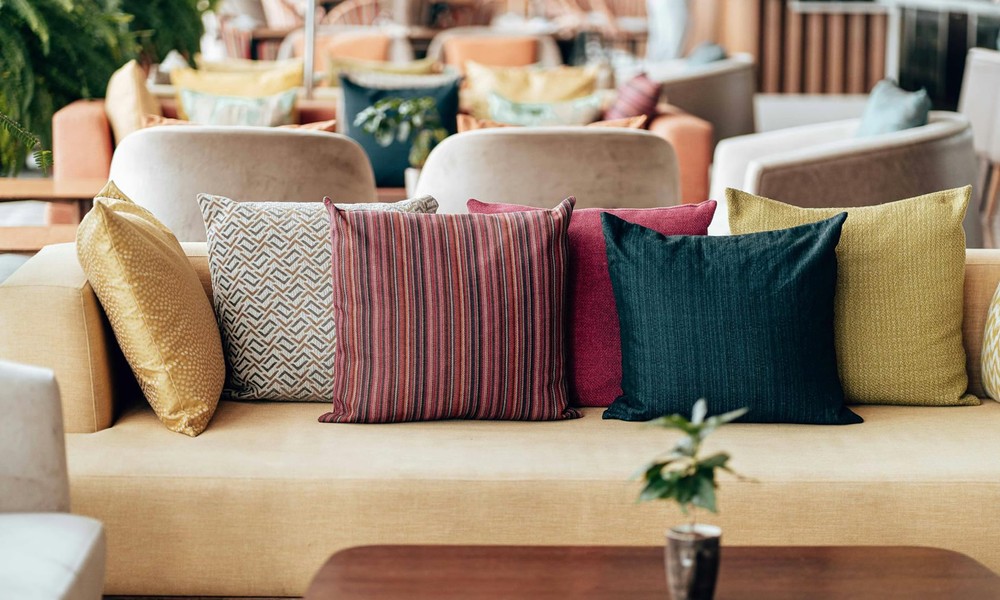
Every sofa you have ever sat on, every curtain you have drawn, every cushion you have plumped – each one carries within it hundreds of metres of machine-sewn thread. The equipment responsible is rarely photographed, rarely celebrated, and almost never seen by the people who live with its output. Yet the industrial sewing machine is one of the most consequential tools in interior manufacturing, and understanding how it shapes the products around us reveals a world of precision, specialisation, and genuine craft.
Built for a Different League
Domestic sewing machines and industrial sewing machines share a name and little else. Where a home machine is a generalist, capable of a range of light tasks at modest speed, an industrial machine is a specialist – engineered for one category of stitch, one family of materials, and continuous operation at speeds of 1,500 to 5,500 stitches per minute without overheating or losing tension.
Several features define industrial sewing machines in an upholstery context. The walking foot – also called a compound or triple feed – is perhaps the most important. Rather than relying on bottom feed dogs alone, a walking foot actively grips and advances the top layer of fabric in synchrony with the bottom, preventing the layer-creep and seam misalignment that plague heavy or foam-backed materials on standard machines. Heavy-gauge needles (metric sizes 18 to 25) penetrate multiple fabric layers, leather, and vinyl cleanly and repeatedly without deflecting. And bonded polyester thread – treated with resin to reduce needle friction and resist abrasion – is the standard consumable across most upholstery applications.
A professional upholstery workshop is not equipped with one machine but many, each dedicated to a specific operation. Lockstitch machines, post-bed machines, cylinder-arm machines, quilting machines, and blindstitch machines each play a distinct role, and the sequencing of operations across those machines is as important as the machines themselves.
Machine Types and What They Do
Lockstitch machines produce the fundamental two-thread interlocked stitch that forms the basis of nearly every upholstery seam. Fitted with a walking foot, they handle panel joining, cushion borders, curtain hems, heading tape application, and zip insertion – in short, the majority of sewing in any soft furnishings workshop.
Post-bed machines raise the sewing surface onto a narrow cylindrical column, allowing the operator to manoeuvre three-dimensional objects around the needle. This geometry is indispensable when sewing inside tight curves – the scroll of a chair arm, the inner radius of a sofa back – where a flat-bed machine simply cannot reach. Post-bed machines are standard equipment for any workshop producing shaped furniture covers.
Cylinder-arm machines extend a narrow horizontal arm from the machine body, enabling fabric to be fed around it in a continuous sleeve. They are the machine of choice for sewing boxing strips – the gusset panels that give box cushions their depth – fully in the round, and for any tubular construction such as curtain loops or bolster end-seams.
Quilting machines stitch through face fabric, wadding, and backing simultaneously, holding the layers together while creating decorative surface pattern. Single-needle machines with pantograph guides handle bespoke work; multi-needle and CNC-controlled quilting machines serve high-volume production of mattress panels, headboards, and premium cushion covers.
Blindstitch machines sew a stitch that catches only a few threads on the face of the fabric, leaving the hem entirely invisible from the front. They are the standard tool for bottom hems on curtains and roman blinds, and for any application where a clean, uninterrupted fabric face is required.
Overlock machines trim and encase raw fabric edges in a looped stitch to prevent fraying. They operate upstream of assembly, processing cut panels before they reach the main sewing stage.
Sofas and Chairs: Three-Dimensional Problem-Solving
A three-seat upholstered sofa may contain thirty or more individually cut fabric panels. Producing the sewn cover involves a structured sequence of operations: overlocking raw edges, preparing and attaching piping, joining panels in a specific order, tailoring curves, inserting zips, and constructing cushion covers – all before the fabric is anywhere near the frame it will eventually clothe.
Piping is among the most labour-intensive elements. Bias-cut strips of fabric are wrapped around welt cord and stitched closed, then attached to panel seam lines using a piping foot that holds the cord snugly while the machine stitches as close as possible to it. This is repeated along every seam edge where inside and outside panels will eventually meet – the visual line that defines the shape of the piece.
Panel joining follows a logical build sequence, with machinists working outward from the centre of the cover. Straight seams on flat panels are straightforward lockstitch work. Where panels must follow curved furniture profiles – rounded arm scrolls, the sweep of a tight-back – post-bed machines allow the partially assembled cover to be fed around the needle post, keeping tension consistent through curves that would be impossible to manage on a flat bed.
Chair production follows the same logic at a smaller scale, with the complexity often concentrated in shaped components. A wing chair back involves concave and convex surfaces that must be sewn together without distortion; dining chair seat pads require precise boxing and clean piping at a scale that demands accuracy in a compact area.
Cushions: Precision in a Small Package
Cushion covers are a study in controlled geometry. A simple scatter cushion – two panels sewn on three sides, turned, filled, and closed – is straightforward enough. A box cushion for a sofa seat is considerably more demanding: a top panel, a bottom panel, and a continuous boxing strip must align precisely at every corner, with piping at both horizontal seams and a zip fitted along part of the boxing. Any misalignment in the boxing strip seam produces a cushion that sits skewed; any inconsistency in the piping seam produces a ragged edge.
The boxing strip is typically sewn into a loop on a cylinder-arm machine before being joined to the top and bottom panels. Corner notches cut at the pattern stage guide alignment during sewing. Zips are inserted using a zipper foot on a lockstitch machine, with the zip tape positioned against a guide for consistent placement.
Bolster cushions introduce a further challenge: circular end panels must be set into the tubular body fabric, requiring the circular edge to be notched and eased around the cylinder without pleating. This is skilled work that exposes any inconsistency in the machinist’s tension control.
Curtains: Length, Scale, and the Invisible Hem
Curtain production scales up the demands of precision across much larger fabric areas. A pair of full-length lined and interlined curtains for a tall window may involve four or more fabric widths per curtain, each joined with flat fell seams, a heavy interlining layer slip-stitched or machine-stitched to the face fabric, and a lining hemmed separately at the bottom.
The heading – the top of the curtain that carries the hooks or rings – is among the most visible elements of the finished product, and its accuracy determines how evenly the curtain hangs. Heading tape is applied in two parallel rows of lockstitch, typically using a guided tape-feed system in production environments to maintain consistent positioning. Where decorative headings are required, additional operations follow: pinch pleats are formed and stitched at their base; eyelet headings require reinforced fabric and mechanically punched metal eyelets fitted around a stitched perimeter seam.
Bottom hems on face fabric are typically sewn on a blindstitch machine, particularly in quality workrooms. The blindstitch leaves no visible thread on the face of the curtain – an invisible finish that marks the difference between a professionally made curtain and an amateur one. Where weighted tape is incorporated into the hem for better drape, a modified presser foot guides the tape into position as the hem is stitched.
Blinds: Where Stitching Determines Function
Window blinds illustrate how stitching decisions affect not just appearance but mechanical performance. In a roman blind, the horizontal fold lines that create the stacked pleats are formed by stitch channels sewn across the full width of the blind at precisely calculated intervals. If those lines are not perfectly horizontal, or if the spacing varies, the blind will fold unevenly when raised and sit crooked when lowered. Industrial machines with adjustable stitch guides – or CNC-controlled stitch positioning – place these channels accurately across the full width of the panel. The channels must also be dimensionally consistent to accommodate the timber or fibreglass rods inserted through them.
Roller blind hems are simpler – a folded channel for a bottom weight rod, sewn on a lockstitch machine – but must be straight and consistently positioned. Sheer and voile blinds demand a different approach entirely: lightweight fabrics require fine needles, reduced foot pressure, and narrow hemming feet to turn and stitch very fine hems without gathering or distorting the weave.
Ring attachment – fitting the lift cord rings to the back of a roman blind at marked positions – is performed by machine using a button-sewing machine adapted for the purpose, or by hand on bespoke pieces.
Soft Furnishings: The Wider World
The same machines that build sofas and curtains serve the full breadth of soft furnishings production. Quilted bedspreads are produced on multi-needle quilting machines in a single pass through face fabric, wadding, and backing. Bed valances are gathered at production speed using industrial shirring plates and gathering feet on lockstitch machines. Table linen for the hospitality sector – tablecloths several metres wide – is hem-sewn on machines with extended roller tables that support the full cloth area.
High-volume scatter cushion production for retail uses a line model: one operator overlocks, another inserts zips, another sews the main seam, and another turns and finishes. Each station uses the appropriate machine and processes dozens of units per hour.
Outdoor and marine upholstery imposes additional constraints. Solution-dyed acrylic canvas, PVC-coated fabric, and technical synthetics require PTFE-coated or roller presser feet to prevent the fabric surface from gripping and stalling under the foot, and marine-grade UV-resistant polyester thread that will not degrade in prolonged sunlight or moisture exposure. Automotive trim – seats, door panels, and dashboards – follows the same fundamental principles with even tighter tolerances, and decorative stitch lines on premium leather interiors are sewn on CNC-guided machines following digitally programmed paths accurate to the millimetre.
The Machinist at the Centre
Technology enables, but does not replace, the skilled machinist. Pattern matching – aligning a large-repeat fabric across every seam of a sofa cover – requires visual acuity and precise seam allowance control that no machine applies automatically. Easing a curved panel without distortion, sewing a consistent piping radius around a tight corner, recognising when a seam has drifted and correcting before the error compounds – these are judgements made by the operator, not the machine.
Quality control in an upholstery workshop is continuous and sequential. Each operation is checked before the piece moves to the next stage: seam allowances measured, welt alignment inspected, zip function tested, stitch density verified. A defect found at the sewing stage costs minutes to fix. The same defect found after the cover is fitted to the frame may cost hours – or the piece entirely.
The industrial sewing machine is a precision instrument. The machinist who operates it is the reason that precision becomes a finished product.
Conclusion
Every category of soft furnishings – from the deep-buttoned back of a Chesterfield to the blind on a bathroom window – depends on industrial sewing machines working within a structured production process. The machines are varied, specialised, and matched to specific operations; the materials they handle are demanding; and the standards they must meet are set by what people will see and touch in their homes every day.
What makes this industry interesting is the combination it demands: mechanised speed and consistency on one hand, irreplaceable human skill and judgement on the other. The seam running along the arm of a well-made chair is not glamorous. But it is the product of considerable knowledge, carefully applied – and it is holding everything together.