

Essential Services for Business Growth and EfficiencyIntroduction
In today’s business world, simply having a great product or service isn’t enough. To truly thrive and scale, small and medium-sized businesses (SMBs) need a robust support system. We know that focusing on your core mission is paramount, but what about all the essential tasks that keep your operations running smoothly behind the scenes?
This is where Business Support Services come in. These vital functions are the unsung heroes that enable companies to boost efficiency, ensure compliance, and achieve sustainable growth. From managing complex IT infrastructure to streamlining daily administrative tasks, these services are the backbone of modern enterprise.
In this extensive guide, we will explore what business support services are and why they’re crucial for SMBs in May 2026. We’ll delve into the most common types of services, discuss the benefits of outsourcing versus in-house management, and highlight how to access valuable free and low-cost resources. Our aim is to provide a comprehensive understanding that empowers your business to make informed decisions and focus on what you do best.
Defining Business Support Services and Their Role in Modern Enterprise
At its core, business support services encompass the array of non-physical products, skilled labor, and internal processes that keep an organization functioning efficiently without directly selling its primary offerings. These are the foundational activities that ensure a company runs smoothly, allowing core teams to concentrate on their primary objectives and deliver value to customers. Think of them as the vital “engines” that power the entire operation, as KPMG aptly describes their internal support functions.
These services are not about the product or service a business sells, but rather the operational scaffolding that enables its creation, delivery, and ongoing success. They include everything from managing finances and human resources to maintaining IT systems and ensuring legal compliance. While often operating behind the scenes, their impact on a business’s stability, growth, and profitability is profound. They address the market demand for specialized expertise, freeing up internal resources and providing access to capabilities that might be too expensive or complex to develop in-house.
The Impact of Business Support Services on Operational Efficiency
The strategic utilization of business support services directly translates into enhanced operational efficiency. By entrusting non-core, yet critical, tasks to specialized providers or dedicated internal units, businesses can optimize resource allocation. This means that valuable employee time and capital can be channeled towards innovation, market expansion, and customer engagement – activities that directly drive revenue and competitive advantage.
Furthermore, these services play a crucial role in risk mitigation. Experts in areas like legal compliance, cybersecurity, and financial reporting ensure that businesses adhere to regulatory standards, safeguarding against potential penalties, data breaches, or financial irregularities. This includes navigating complex governance, risk, and compliance (GRC) policies, which are increasingly stringent in May 2026. Scalability is another significant benefit; as a business grows, support services can be scaled up or down to match demand, avoiding the fixed costs and complexities associated with expanding internal departments. Outsourcing, in particular, allows SMBs to lower operational costs, access specialized expertise they might not otherwise afford, and free up internal staff to focus on strategic growth initiatives.
Distinguishing Support from Core Strategic Functions
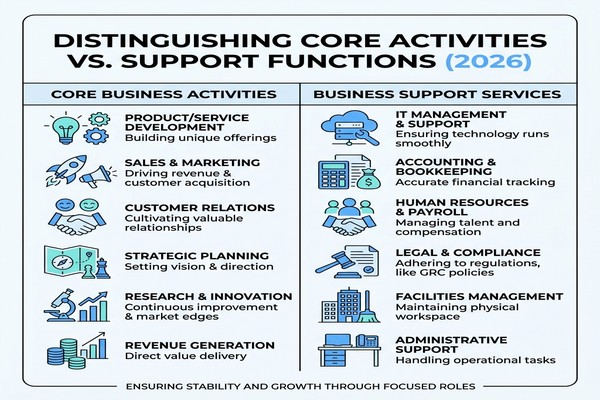
It’s essential to differentiate between a business’s core strategic functions and its support activities. Core activities are those directly involved in generating revenue, developing primary products or services, and engaging with the market. These are the unique differentiators that define a company’s competitive edge. For instance, a software company’s core function is developing and selling software, while a consulting firm’s core is providing expert advice.
Support functions, on the other hand, manage the administrative burden and back-end operations that facilitate these core activities. While indispensable, they are typically not revenue-generating in themselves. Strategic oversight, leadership, and employee relations are often best kept in-house, as they are intrinsically linked to a company’s culture and unique business identity. However, tasks like payroll processing, IT management, and legal counsel, while critical, can often be handled more efficiently by external specialists. This distinction allows businesses to maintain tight control over their strategic direction while leveraging external expertise for specialized, routine, or highly technical tasks.
Core Business Activities Business Support Services Product/Service Development IT Management & Support Sales & Marketing Accounting & Bookkeeping Customer Relations Human Resources & Payroll Strategic Planning Legal & Compliance Research & Innovation Facilities Management Revenue Generation Administrative Support
For a business to truly thrive, ensuring the underlying technology infrastructure is robust and reliable is paramount. This is where dedicated IT support services come into play. They provide the necessary expertise to maintain systems, secure data, and ensure seamless operations, allowing businesses to focus on their core mission without technical distractions. To learn more about how specialized IT support can empower your business, consider exploring how you can Streamline Fast Business IT.
Common Types of Business Support Services for SMBs

For small and medium-sized businesses, the landscape of available support services is vast and varied, designed to address virtually every non-core operational need. These services are the bedrock upon which efficient and compliant businesses are built, allowing entrepreneurs to focus on their vision rather than getting bogged down in administrative minutiae. Among the most common types, we frequently encounter human resources, financial reporting, facilities management, payroll processing, and legal services. Each plays a distinct yet interconnected role in fostering a healthy business environment.
Human resources support, for instance, can range from recruitment and onboarding to benefits administration and compliance with labor laws. Financial reporting and accounting services ensure accurate record-keeping, provide critical insights into financial health, and prepare businesses for tax season. Facilities management handles the upkeep of physical premises, ensuring a safe and productive work environment. Payroll processing, a complex and time-sensitive task, ensures employees are paid accurately and on time, while legal services protect the business from potential liabilities and guide it through regulatory complexities. These services, whether managed internally or outsourced, are critical for maintaining stability and enabling growth. Businesses in specialized sectors, such as the home service industry, often benefit from tailored operational support to manage their unique challenges, highlighting the diverse needs across different types of enterprises. For those looking for dedicated assistance in this area, resources for Home service business support can be invaluable.
Specialized Financial and Accounting Support
Financial and accounting support services are indispensable for SMBs, providing the backbone for sound fiscal management. These services go beyond simple bookkeeping, encompassing strategic tax planning, meticulous audit preparation, and the generation of crucial financial statements like cash flow and profit-and-loss reports. In May 2026, businesses must be particularly vigilant about their financial planning due to a rare “27-pay-period year,” which requires advanced consideration for salaries, benefits, and payroll processing to avoid unexpected financial impacts. Expert providers like Business Support Services Northwest emphasize that while almost anyone can crunch numbers, businesses often require more comprehensive support, including accurate balance sheets and reliable forecasts.
For businesses with international aspirations, specialized accounting services can also address complex requirements such as economic substance rules, which mandate a certain level of local presence and activity in specific jurisdictions. This ensures compliance with global tax regulations and facilitates smoother international operations. Whether it’s managing complex payroll decisions to save money, preparing for audits, or providing advanced QuickBooks support, these financial specialists offer the expertise needed to navigate an increasingly intricate financial landscape, allowing business leaders to make informed decisions and maintain fiscal health.
Technical Infrastructure and Managed IT
In our digital age, robust technical infrastructure and reliable IT support are non-negotiable for any business. Technical infrastructure and managed IT services cover a broad spectrum, including cybersecurity, cloud migration, help desk support, network stability, and software maintenance. For many SMBs, the cost and complexity of maintaining an in-house IT department are prohibitive, making outsourced IT a strategic necessity. Providers in regions like South Florida, for example, highlight the importance of proactive IT monitoring to prevent issues before they arise, saving businesses significant time and money. They often offer one low fixed monthly fee to cover end-to-end managed IT services, providing predictability and transparency in budgeting.
Cybersecurity, in particular, has become a top priority. With cybercrime becoming increasingly sophisticated, businesses need expert protection against data breaches and system vulnerabilities. Managed IT services ensure that systems are continuously monitored, patched, and updated, providing a critical layer of defense. Cloud migration services help businesses leverage scalable and flexible cloud solutions, while efficient help desk support ensures that any technical glitches are resolved swiftly, minimizing downtime. This allows businesses to focus on their core operations, confident that their technological foundation is secure and efficiently managed. When it comes to presenting a professional image, businesses often invest in high-quality visual elements. Just as a strong IT infrastructure supports internal operations, professional branding, such as Custom Business Signage, plays a crucial role in external perception and market presence.
Strategic Decision-Making: In-House Management vs. Outsourcing

One of the most critical decisions businesses face regarding support services is whether to manage them in-house or outsource them to external providers. This choice involves a careful cost-benefit analysis, weighing factors such as control, expertise, cost, and strategic focus. While keeping all functions in-house might offer greater direct control, it often comes with significant overheads, including salaries, benefits, training, and infrastructure. Outsourcing, conversely, allows businesses to tap into specialized expertise without the associated fixed costs, often providing access to advanced tools and methodologies that would be otherwise inaccessible.
However, certain functions, particularly those deeply intertwined with company culture, employee relations, or strategic oversight, are often best kept in-house. These include core leadership, strategic planning, and sensitive HR functions where intimate knowledge of the organization is paramount. For outsourced services, establishing clear Service Level Agreements (SLAs) is vital. These contracts define the scope of work, performance metrics, and responsibilities, ensuring accountability and managing expectations. Effective vendor management then becomes crucial to oversee these relationships and ensure the outsourced services align with business objectives. Deloitte emphasizes that an effective approach often involves a flexible mix of in-house and external resources, tailored to the specific needs and operating model of each business.
Key Benefits of Outsourcing for Small and Medium Businesses
Outsourcing business support services offers a multitude of advantages, particularly for SMBs looking to maximize efficiency and accelerate growth. One of the most immediate benefits is significant overhead reduction. By converting fixed costs (like salaries and infrastructure) into variable costs, businesses can achieve greater financial flexibility. This also often translates into 24/7 monitoring and support, especially for IT services, ensuring continuous operation and rapid response to issues, even outside standard business hours.
Furthermore, outsourcing provides access to advanced tools and specialized expertise that would be costly to maintain internally. For instance, firms like KPMG are aggressively integrating AI into their support services, offering clients the benefit of cutting-edge technology without the need for internal investment. This helps businesses overcome talent gaps, particularly in highly specialized fields like advanced accounting, cybersecurity, or complex HR. By offloading these non-core functions, business leaders and their teams can dedicate their time and energy to core competencies, innovation, and strategic initiatives that directly drive revenue and market expansion. This focus on growth, supported by reliable external partners, can be a game-changer for SMBs striving for competitive advantage.
Selecting the Right Business Support Services Provider
Choosing the right business support services provider is a decision that can significantly impact a company’s success. It’s not merely about finding the cheapest option, but rather identifying a partner that aligns with your business values, understands your unique needs, and can deliver consistent, high-quality results. Several factors should weigh heavily in this selection process.
First, consider their industry experience. A provider with a deep understanding of your specific sector will be better equipped to anticipate challenges and offer tailored solutions. Local presence can also be a significant advantage, particularly for IT or on-site administrative support, ensuring faster response times and a more personalized approach. Transparency in pricing is crucial; look for providers who offer clear, fixed-fee structures to avoid hidden costs and unexpected expenses. Scalability is another key consideration – can the provider grow with your business, adapting their services as your needs evolve? Technical proficiency, especially in areas like IT and financial management, is non-negotiable. Finally, a provider’s reputation, built on trust and reliability, should be thoroughly vetted through testimonials, case studies, and references. Building a strong relationship with your support provider, as emphasized by Business Support Services Northwest, is paramount for effective long-term partnership.
Accessing Free and Low-Cost Business Support Resources
For many small and medium-sized businesses, particularly startups, the cost of professional support services can be a significant barrier. Fortunately, a wealth of free and low-cost resources exists, often backed by government initiatives and non-profit organizations, designed to empower entrepreneurs and foster economic growth. These resources provide invaluable guidance, training, and mentorship that can be just as impactful as paid services.
The U.S. Small Business Administration (SBA) is a cornerstone of this ecosystem, partnering with various organizations to offer comprehensive support. Key among these are SBA Resource Partners like SCORE, which connects business owners with expert mentors at no cost. Small Business Development Centers (SBDCs) provide entrepreneurial training and counseling, often hosted by universities or state agencies. Additionally, specialized centers like Veterans Business Outreach Centers (VBOCs) and Women’s Business Centers (WBCs) cater to the unique needs of specific demographics, offering targeted advice and resources. These networks are designed to provide local, accessible assistance, often allowing businesses to find support simply by entering their ZIP code.
The Economic Impact of Professional Mentoring
The value of professional mentoring, particularly from organizations like SCORE and SBDCs, extends far beyond individual business success; it generates a significant economic ripple effect. Statistics powerfully illustrate this impact. Small business owners who receive three or more hours of mentoring consistently report higher revenues and faster growth compared to those who do not. In a single fiscal year (FY24), SCORE supported the launch of nearly 60,000 new small businesses and contributed to the creation of over 140,000 new jobs.
The return on investment for taxpayer dollars is equally impressive. America’s SBDCs, for example, delivered a remarkable 10x return on investment and helped clients secure over $5.5 billion in capital. For every $1 of federal funding, SCORE generated a staggering $45.42 return in new federal tax revenue in FY24. These figures underscore that free or low-cost mentoring is not just a handout; it’s a strategic investment in the national economy, fostering job creation, capital security, and sustainable revenue growth across countless communities.
Leveraging Government and Non-Profit Networks
Beyond direct mentoring and counseling, government and non-profit networks offer a broad spectrum of resources crucial for business development. These include specialized entrepreneurial training programs tailored to various stages of business growth, from ideation to scaling. For businesses looking to secure government contracts, these networks provide guidance on federal contracting processes, helping SMBs navigate the complexities of public sector procurement.
Furthermore, initiatives like Regional Innovation Clusters foster collaboration and growth within specific industries, connecting businesses with research institutions, investors, and other key players. For companies aiming to expand globally, export assistance programs offer vital support for navigating international trade regulations and market entry strategies. Many organizations, such as SCORE, also provide practical tools like “Startup Roadmaps” and templates for business plans and financial statements, equipping entrepreneurs with the foundational knowledge needed to launch and grow their ventures successfully. These comprehensive resources ensure that businesses have access to the information and support they need, regardless of their stage or sector.
Frequently Asked Questions about Business Support Services
What are the most critical support services for a new startup?
For a new startup, the most critical support services are those that establish a solid foundation for legal compliance, financial management, and operational efficiency. Initially, this often includes legal services for business registration, intellectual property protection, and contract drafting. Robust accounting and bookkeeping are paramount to track expenses, manage cash flow, and prepare for tax obligations. Payroll services become critical as soon as the first employee is hired, ensuring accurate and timely compensation and compliance with labor laws. Additionally, basic IT support is essential for setting up secure networks, email systems, and ensuring reliable connectivity. As the startup grows, these foundational services will need to scale, with HR support for recruitment and talent management, and more sophisticated cybersecurity measures becoming increasingly important.
How does AI integration change the landscape of business support?
AI integration is revolutionizing business support by dramatically enhancing efficiency, automating routine tasks, and enabling deeper insights. Companies like KPMG are leading the charge, empowering their support professionals with numerous AI tools and extensive training. This shift allows employees to move away from mundane, repetitive tasks and focus on critical thinking, problem-solving, and more strategic contributions. AI can automate data entry, generate reports, streamline customer service through chatbots, and even assist in legal research or financial analysis. The result is faster service delivery, reduced human error, and the ability to process vast amounts of information more effectively, fundamentally transforming how support functions operate and deliver value.
Why is data cleanliness important before implementing automated support tools?
Data cleanliness is absolutely critical before implementing any automated support tools, especially those powered by AI. As CBIZ research highlights, “poor data leads to failed AI implementation.” AI and automation tools rely on high-quality, accurate, and consistent data to function effectively. If the underlying data is messy, incomplete, or incorrect, the automated processes will produce flawed results, leading to incorrect decisions, operational inefficiencies, and a loss of trust in the system. Investing in data cleansing and organization is therefore a prerequisite for successful AI adoption. It ensures that automated tools can accurately analyze information, make reliable predictions, and execute tasks correctly, maximizing the return on investment in these advanced technologies.
Conclusion
In May 2026, the strategic utilization of business support services is no longer a luxury but a fundamental requirement for achieving operational excellence and sustainable growth. From the intricate details of financial management and the complexities of IT infrastructure to the invaluable guidance of expert mentors, these services form the invisible yet indispensable framework that allows businesses to thrive.
By understanding the distinction between core activities and support functions, and by making informed decisions about in-house management versus outsourcing, businesses can unlock significant efficiencies, mitigate risks, and gain access to specialized expertise. The availability of free and low-cost resources further democratizes access to critical support, empowering even the smallest startups to build robust foundations. Embracing business support services as strategic partnerships fosters long-term efficiency, enhances business resilience, and allows entrepreneurs to concentrate on their unique vision, driving innovation and success in an ever-evolving market.