

The Role of Social Media in Modern Digital Marketing
In today’s dynamic digital landscape, social media is no longer just a communication channel. It is a critical engine for business growth and customer connection. For brands seeking to thrive, mastering Social Media Management is absolutely essential. It involves much more than simply sharing content; it’s about strategically engaging audiences and building lasting communities.
This guide will provide a comprehensive roadmap for navigating the complexities of social media in 2026. We will explore everything from fundamental principles and essential tools to cutting-edge trends and the transformative role of AI.
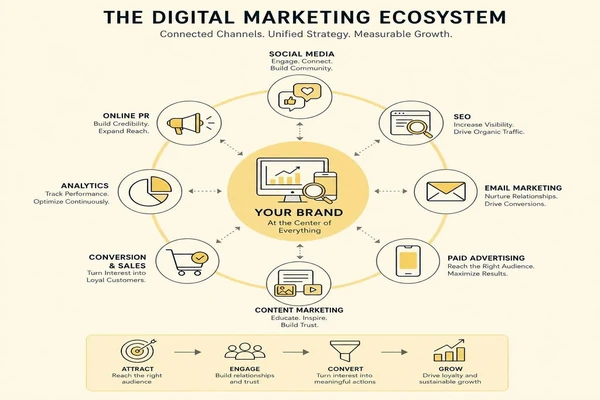
Understanding how to develop an Integrated digital social media strategy is key to unlocking your brand’s full potential online. Our aim is to equip you with the knowledge needed to drive real impact and achieve measurable success.
Social media has evolved into a cornerstone of modern digital marketing, moving far beyond its initial purpose as a simple communication tool. For businesses in 2026, it represents a multifaceted platform for achieving diverse objectives, from enhancing brand awareness to fostering deep customer loyalty and expanding market reach. With over 5.41 billion social media users worldwide, the sheer scale of the audience presents an unparalleled opportunity for brands to connect with potential and existing customers.
Our presence on social platforms allows us to cultivate a distinct brand identity, ensuring consistent messaging and visual representation across all touchpoints. This consistency is vital for building trust and recognition in a crowded digital space. Furthermore, social media plays a crucial role in customer retention by providing direct channels for support, feedback, and community engagement. By actively participating in conversations and addressing customer needs, brands can significantly strengthen relationships and encourage repeat business. The ability to reach a global audience, target specific demographics, and drive traffic to other digital assets makes social media an indispensable component of any robust marketing strategy. It’s a dynamic environment where trends emerge rapidly, algorithms shift overnight, and customer expectations for instant, authentic interaction are at an all-time high.
Defining Social Media Management Within Digital Marketing
Social media management is the strategic process of overseeing and optimizing a brand’s presence across various social platforms. It’s an ongoing, dynamic discipline that encompasses everything from crafting compelling content to engaging with audiences and analyzing performance. At its core, social media management is about translating overarching business objectives into actionable social media strategies. This involves fostering organic growth by creating value-driven content that naturally attracts and retains followers, rather than solely relying on paid promotion.
A key aspect is community building, which means cultivating an environment where followers feel connected to the brand and to each other. This often involves encouraging user-generated content, facilitating discussions, and responding thoughtfully to comments and messages. Maintaining a consistent brand voice across all platforms is paramount, ensuring that every interaction reinforces the brand’s personality and values. This requires a deep understanding of the brand’s identity and how to adapt it authentically to the nuances of each social network. Effective social media management is not just about posting; it’s about strategically nurturing an audience, fostering loyalty, and ultimately contributing to long-term business goals. For a truly cohesive approach, considering an All-in-One Social Content and Management solution can streamline these complex processes.
Key Differences Between Social Media Management and Marketing
While often used interchangeably, social media management and social media marketing serve distinct, yet complementary, functions within a brand’s digital strategy. Social media marketing is the broader, strategic umbrella, focusing on defining overarching goals, identifying target audiences, and developing comprehensive campaigns to achieve specific business objectives, such as lead generation, sales, or brand awareness. It sets the direction and the “why” behind social media activities. For a deeper dive into strategic planning, exploring resources like a Social Media Marketing Strategy guide from Multimedia Solutions can be highly beneficial.
Social media management, on the other hand, is the tactical, day-to-day execution arm. It’s the “how” and the “what” of social media. This involves tasks like content creation, scheduling posts, monitoring mentions, engaging with comments, responding to messages, and analyzing performance metrics. Marketing defines the campaign goals (e.g., increase website traffic by 20%), while management executes the posts, interactions, and reporting that contribute to that goal.
The distinction can be summarized as follows:
Feature Social Media Marketing Social Media Management Primary Focus Strategic planning, goal setting, campaign design Daily execution, content scheduling, community engagement Objective Achieve business goals (sales, leads, brand awareness) Maintain brand presence, foster community, drive interaction Scope Broad strategy, market research, campaign ideation Tactical implementation, content calendar, analytics Key Activities Audience segmentation, competitive analysis, budget allocation Content creation, scheduling, monitoring, responding Time Horizon Long-term (months to years) Short-term to medium-term (daily to monthly) Despite their differences, these two functions are inextricably linked. Effective social media marketing relies on robust social media management for successful implementation, and management without a clear marketing strategy risks being directionless. The most impactful results come when both work in seamless alignment, with marketing providing the strategic framework and management ensuring flawless, engaging execution.
Essential Skills for Modern Social Media Managers
The role of a social media manager in 2026 demands a diverse and evolving skill set that blends creativity with analytical prowess. It’s a position that requires constant adaptation to new platforms, changing algorithms, and shifting audience behaviors.
Firstly, content creation remains fundamental. This isn’t just about writing captions; it includes visual storytelling, understanding graphic design principles, basic video editing for short-form content, and crafting compelling narratives that resonate with the target audience. A social media manager must be adept at tailoring content to suit the unique characteristics of each platform.
Secondly, data analysis is critical. Social media generates vast amounts of data, and the ability to interpret engagement rates, reach, impressions, click-through rates, and conversion metrics is essential for refining strategies and proving ROI. This involves not just pulling reports but understanding what the numbers mean and how to turn insights into actionable steps.
Thirdly, crisis communication and reputation management are increasingly vital. In an age where a single misstep can go viral, managers must be prepared to respond quickly, empathetically, and strategically to negative feedback or public relations challenges. This requires a calm demeanor, excellent writing skills, and a clear understanding of brand guidelines.
Finally, trendspotting and a deep understanding of platform nuances are non-negotiable. The social landscape is in constant flux, and managers must be “chronically online” (as 94% of social pros feel they need to be, according to The 2025 Sprout Social Index™) to identify emerging trends, understand new features, and adapt strategies accordingly. This includes staying abreast of AI advancements and knowing how to leverage AI tools for efficiency without sacrificing authenticity. For those looking to formalize their expertise, educational pathways like a Tri-C Social Media Marketing Short-Term Certificate can provide a structured foundation in these critical areas.
The Five Core Pillars of Social Media Management
Effective social media management is built upon a foundation of five interconnected pillars. These pillars provide a structured framework for consistent brand presence, meaningful audience engagement, and data-driven decision-making. By mastering each of these areas, brands can ensure their social media efforts are not just active, but truly impactful, leading to sustained growth and stronger customer relationships. This holistic approach ensures that every aspect of a brand’s social footprint is optimized for success, transforming scattered efforts into cohesive, results-oriented campaigns.
Pillar 1: Strategy and Planning
The first and most crucial pillar is Strategy and Planning. Before any content is created or posted, a clear, well-defined strategy must be in place. This involves a deep dive into audience research, understanding demographics, psychographics, online behaviors, and pain points to tailor content that truly resonates. Identifying the right network selection is also key; not every platform is suitable for every brand, and resources should be focused where the target audience is most active and receptive.
Developing a robust content mix ensures variety and keeps the audience engaged. This might include educational posts, behind-the-scenes glimpses, promotional content, interactive polls, and user-generated content. A content calendar is an indispensable tool here, allowing for organized scheduling and consistent delivery. Furthermore, setting clear, measurable goals (e.g., increase engagement rate by X%, grow follower count by Y%) provides a benchmark for success and guides all subsequent activities. This strategic foresight ensures that every social media action is purposeful and aligned with broader business objectives, contributing effectively to an All-in-One Marketing Funnel.
Pillar 2: Content Creation and Publishing
Once the strategy is set, the next pillar focuses on bringing that strategy to life through compelling content creation and publishing. This pillar is where creativity meets consistency. Brands must develop a steady stream of high-quality, relevant content tailored to each platform’s unique format and audience expectations. This includes crafting engaging copywriting for captions, designing eye-catching visual assets like graphics and images, and producing dynamic short-form video. Short-form video, in particular, has become a dominant force, driving 2-8 times more engagement than static posts, making it an essential component of any content strategy in 2026.
Beyond creation, effective publishing involves understanding optimal posting times for maximum reach and engagement. Leveraging analytics to identify when your specific audience is most active allows for strategic scheduling. Automation tools can help streamline this process, ensuring content goes out consistently without requiring constant manual intervention. However, it’s crucial to customize content for each network, rather than simply cross-posting identical messages, to ensure authenticity and maximize impact.
Pillar 3: Community Management and Engagement
The third pillar, Community Management and Engagement, is about fostering genuine connections and building a loyal audience. Social media is inherently a two-way street, and success hinges on active, authentic interaction. This means moving beyond broadcasting messages to actively participating in conversations. Brands must prioritize two-way dialogue, responding to comments, direct messages, and mentions promptly and thoughtfully. The 2025 Sprout Social Index™ reveals that 73% of social users agree that if a brand doesn’t respond on social, they’ll buy from a competitor, highlighting the critical importance of responsiveness.

Effective customer care on social media can transform potential complaints into opportunities for loyalty. A unified inbox, which aggregates messages from various platforms, can significantly improve response times and ensure no query goes unanswered. Beyond reactive responses, proactive engagement involves asking questions, running polls, and initiating discussions to encourage audience participation. Building brand loyalty through social media means creating a sense of belonging, making customers feel heard, valued, and part of a larger community. This human-centric approach is what differentiates successful brands in the digital age.
Pillar 4: Social Listening and Monitoring
The fourth pillar, Social Listening and Monitoring, involves actively tracking and analyzing conversations happening about your brand, industry, and competitors across the social web. This goes beyond simply responding to direct mentions; it’s about understanding the broader sentiment and identifying untapped opportunities or potential threats.
Sentiment analysis helps gauge public perception of your brand, products, or campaigns, allowing for quick adjustments if sentiment turns negative. Monitoring brand mentions-both tagged and untagged-ensures that you’re aware of all conversations relevant to your business. This proactive approach is crucial for online reputation management. Competitor tracking provides valuable insights into what your rivals are doing well, where they might be falling short, and emerging trends they are capitalizing on. This intelligence can inform your own strategy development. Finally, social listening is a powerful tool for crisis prevention. By detecting early warning signs of negative sentiment or trending issues, brands can intervene before a minor problem escalates into a full-blown public relations crisis. Setting up alerts for specific keywords and brand mentions allows for real-time awareness and rapid response.
Pillar 5: Analytics and Reporting
The final pillar, Analytics and Reporting, is about measuring the effectiveness of your social media efforts and demonstrating their value to the business. Without robust analytics, social media activities risk being guesswork rather than strategic investments. This pillar involves tracking key performance metrics such as reach, impressions, engagement rates, follower growth, website clicks, and conversions.
The goal is to move beyond vanity metrics to focus on data that drives tangible business outcomes. Data-driven decisions are made possible by regularly reviewing performance reports, identifying what content performs best, understanding peak engagement times, and optimizing strategies based on these insights. Creating comprehensive executive reporting is essential for communicating the ROI of social media to leadership, highlighting how social efforts contribute to lead generation, sales, and overall brand health. Metrics like “share of voice” can also illustrate your brand’s prominence within industry conversations. Regularly reviewing these reports allows for continuous optimization, ensuring that resources are allocated effectively and strategies are constantly refined for maximum impact.
Essential Tools for Modern Workflows
Navigating the complexities of social media management in 2026 requires a suite of sophisticated tools that streamline workflows and provide actionable insights. While we won’t name specific platforms, it’s crucial to understand the categories of tools that empower modern social media professionals.
Scheduling software is fundamental, allowing teams to plan, create, and automate the publishing of content across multiple social networks from a single dashboard. These tools often include content calendars, approval workflows, and features to identify optimal posting times.
Listening platforms are vital for monitoring brand mentions, tracking sentiment, analyzing competitor activity, and identifying emerging trends. They act as a brand’s eyes and ears across the social web, providing real-time alerts and comprehensive reports.
Analytics dashboards consolidate performance metrics from all social channels into easy-to-understand visualizations. These tools help measure ROI, track campaign effectiveness, and inform strategic adjustments. They move beyond basic platform analytics to offer deeper insights into audience behavior and content performance.
Finally, asset libraries or digital asset management (DAM) systems integrate with these tools to store, organize, and manage all visual and textual content, ensuring brand consistency and easy access for content creators. The trend towards centralized command centers that unify multi-platform management is a unique insight, significantly reducing inefficiencies and providing a holistic view of social media operations. These integrated solutions are transforming how brands manage their social presence, enabling greater efficiency and more strategic decision-making.
How to Start Social Media Management for Your Business
Embarking on social media management for your business, or refining an existing strategy, requires a systematic approach. The first crucial step is to audit existing profiles. This involves taking stock of all current social media accounts, assessing their performance, identifying inconsistencies in branding or messaging, and determining which platforms are genuinely reaching your target audience.
Next, it’s imperative to define clear, measurable goals. Are you aiming for increased brand awareness, lead generation, customer support, or community building? Specific, achievable goals will guide your strategy and provide benchmarks for success. Following this, establish clear brand guidelines for social media. This includes tone of voice, visual aesthetics, approved hashtags, and response protocols. Consistency across all platforms and team members is paramount for building a strong brand identity.
Consider whether your business has the internal resources and expertise to manage these efforts effectively. For many businesses, particularly those looking for specialized local expertise, partnering with a dedicated agency can be a strategic move. For instance, exploring options like a Social Media Marketing Agency in NJ could provide the necessary guidance and execution power to kickstart your social media journey successfully. This foundational work ensures that your social media efforts are purposeful, consistent, and set up for long-term growth.
Maximizing ROI and Engagement in the AI Era
The integration of Artificial Intelligence (AI) into social media management marks a transformative shift, offering unprecedented opportunities to maximize Return on Investment (ROI) and elevate audience engagement. In 2026, AI is not just a buzzword; it’s a practical tool that, when wielded effectively, can drive significant business growth, enhance conversion rates, and boost customer lifetime value. By automating repetitive tasks, providing deeper insights, and even assisting in content creation, AI allows social media professionals to focus on higher-level strategy and authentic human connection. This synergy between human creativity and AI efficiency is the key to unlocking the full potential of social media in the current digital landscape.
How AI is Transforming Digital Marketing Workflows
AI is rapidly reshaping digital marketing workflows, particularly in social media management, by offering capabilities that enhance efficiency, personalization, and strategic insight. Generative AI tools are revolutionizing content creation, assisting with everything from drafting initial post ideas and headlines to suggesting optimized captions tailored for specific platforms. This capability allows social media managers to overcome creative blocks and produce a higher volume of content more efficiently.
Automated captioning and content repurposing tools, powered by AI, can take a single piece of long-form content and generate multiple social media posts, saving significant time. Beyond creation, AI excels in predictive analytics, analyzing vast datasets to forecast trends, identify optimal posting times, and even predict audience sentiment. This allows for proactive strategy adjustments rather than reactive measures.
However, it’s crucial to remember that AI augments rather than replaces human social media managers. While AI can act as a powerful “creative intern” by generating drafts and insights, human oversight is essential for ensuring authenticity, maintaining brand voice, and adding the nuanced personalization that resonates with real people. According to The 2025 Sprout Social Index™, 97% of marketing leaders acknowledge the critical importance of their teams knowing how to use AI in their daily work, underscoring its indispensable role in modern social media management.
Strategies for Growing Audience Engagement
Growing audience engagement on social media in 2026 demands dynamic and responsive strategies that cater to evolving consumer preferences. One of the most effective approaches is to leverage interactive content. This includes polls, quizzes, Q&A sessions, live streams, and user-generated content campaigns, all of which encourage direct participation and foster a sense of community.
As highlighted earlier, short-form video continues to dominate, driving significantly higher engagement than static posts. Brands should prioritize creating compelling Reels, TikToks, and YouTube Shorts, focusing on authentic, entertaining, and informative content. This often means embracing trend hijacking-creatively adapting viral trends to fit your brand’s message, but with careful consideration to ensure it aligns authentically and doesn’t appear forced or opportunistic.
Developing community programs such as exclusive groups, loyalty initiatives, or ambassador programs can also deepen connections and encourage active participation. Furthermore, integrating social media efforts with broader marketing initiatives, such as Paid Social Media Advertising from Zero to Hero in One Hour, can amplify reach and engagement by targeting specific audiences with tailored content. The key is to consistently provide value, spark conversations, and make your audience feel like an integral part of your brand’s story.
Real-World Case Studies and Success Stories
Across various industries, leading brands have demonstrated remarkable success through strategic social media management, illustrating the tangible benefits of a well-executed approach. For instance, a prominent hospitality group, by centralizing its social media strategy across hundreds of accounts, achieved a significant 46% growth in new followers and dramatically improved customer care efficiency. This streamlined approach not only expanded their digital footprint but also enhanced customer satisfaction.
In another instance, a large healthcare provider effectively leveraged employee advocacy programs, empowering its team members to share pre-approved content. This strategy resulted in substantial savings in equivalent ad value, demonstrating the power of authentic voices in extending brand reach. Similarly, a major insurance company, through consolidated social media management, saw a notable 31% increase in online interactions, translating into millions in revenue and operational cost savings.
These examples underscore that effective social media management, often facilitated by unified platforms and data-driven insights, can lead to impressive outcomes. They showcase how brands can achieve substantial follower growth, generate significant ad value savings, experience engagement rate spikes, and ultimately drive measurable revenue through dedicated and intelligent social media strategies. These success stories serve as powerful testaments to the make-or-break impact of social media management in today’s competitive landscape.
Measuring Success and Attributing Business Value
Measuring the success of social media efforts and attributing tangible business value is paramount for demonstrating ROI and justifying ongoing investments. It moves beyond superficial metrics to focus on how social media contributes directly to a brand’s bottom line.
A critical component is accurate ROI calculation, which involves tracking the costs associated with social media activities (tools, staff, ad spend) against the revenue or business value generated. This can include direct sales attributed to social campaigns, lead generation, or even the cost savings from using social media for customer service. Conversion tracking links social interactions to specific actions, such as website visits, form submissions, or purchases, providing a clear path from social engagement to business outcomes.
Integrating social media data with your CRM (Customer Relationship Management) system is a powerful way to understand the full customer journey. This allows you to see how social interactions influence lead nurturing and customer retention, providing a holistic view of customer lifetime value. The goal is to demonstrate how social media contributes to lead generation and other key performance indicators. For businesses in specific regions, working with specialized firms like a Long Island Social Media Agency can help tailor these measurement strategies to local market nuances and business objectives, ensuring that every social media effort is tied back to measurable business value.
Frequently Asked Questions about Digital Marketing and Social Media
As brands navigate the ever-evolving digital landscape, a host of common questions arise regarding effective social media management. Addressing these queries with industry standards and strategic advice is crucial for developing robust and resilient digital marketing strategies. From deciding on internal versus external management to understanding common pitfalls and time commitments, gaining clarity on these points empowers businesses to make informed decisions that drive growth. For comprehensive support and answers to these and other strategic questions, consulting with experts, such as a Social Media Marketing Agency on Long Island, NY, can provide invaluable insights tailored to your specific needs.
Should businesses manage social media in-house or hire an agency?
The decision of whether to manage social media in-house or outsource to an agency is a strategic one, dependent on several factors unique to each business. Managing in-house offers greater control over brand messaging, potentially faster response times, and a deeper understanding of internal company culture. It’s ideal when you have dedicated staff with the necessary skills, time, and resources. However, it requires significant investment in training, tools, and staying abreast of rapidly changing trends.
Hiring an agency, on the other hand, provides access to specialized expertise, cutting-edge tools, and a team of professionals who are constantly immersed in the latest social media trends and algorithm changes. Agencies can bring fresh perspectives, scalability, and often deliver more sophisticated strategies and analytics. This can be particularly beneficial for businesses looking to expand their reach or needing specialized campaigns. The cost-effectiveness can vary; while an agency fee might seem higher, it often covers a team’s worth of expertise, tools, and time that would be expensive to replicate internally. The choice hinges on your current resource allocation, the level of expertise you require, and your desired scalability. For businesses seeking localized expertise, a dedicated partner like a Long Island Social Media Marketing firm can offer tailored solutions that align with regional market dynamics.
What are the most common mistakes to avoid in social media management?
Even with the best intentions, brands can fall victim to common pitfalls in social media management that hinder growth and damage reputation. Understanding these mistakes is the first step toward avoiding them.
One significant error is inconsistency in posting frequency or brand voice. Sporadic activity or a fluctuating tone can confuse your audience and dilute your brand identity. Another critical mistake is ignoring comments and direct messages. In an era where 73% of social users expect a response, failing to engage can lead to customer dissatisfaction and a perception of indifference.
While automation is valuable, over-automation without human oversight can lead to generic, inauthentic interactions that alienate your audience. AI should augment, not replace, genuine human connection. Furthermore, chasing viral trends blindly without considering brand relevance or authenticity is a common misstep. Not every trend is suitable for every brand, and jumping on inappropriate bandwagons can appear opportunistic or out of touch. As a unique opinion, we believe that blindly following viral trends is something brands should avoid at all costs in 2025 and 2026. Instead, focus on creating content that genuinely resonates with your audience and aligns with your brand’s core values.
How much time does effective social media management typically take?
The time commitment for effective social media management can vary significantly depending on the size of the business, the number of platforms managed, the intensity of engagement desired, and the complexity of the content strategy. However, it’s rarely a “set it and forget it” task.
For a small business managing a few platforms, daily monitoring for mentions and messages might take 1-2 hours. Content batching, where content for a week or month is created and scheduled in advance, can take anywhere from 4-8 hours per week, depending on the volume and complexity of posts (e.g., short-form video requires more time). Dedicated community engagement, including proactive interaction and responding to comments, might consume another 1-3 hours daily. Finally, reporting hours-analyzing data, generating insights, and creating performance reports-can add 2-4 hours weekly or more for in-depth analysis.
In total, a dedicated social media manager might spend anywhere from 20-40 hours per week on these tasks for a moderately active brand. For larger enterprises or those with aggressive growth targets, this can easily scale to multiple full-time roles. The key is to allocate sufficient time for strategic planning, creative execution, consistent engagement, and thorough analysis to ensure efforts are impactful and yield measurable results.
Conclusion
In the rapidly evolving digital landscape of 2026, social media management is undeniably a make-or-break factor for brands. It’s a dynamic discipline that requires a strategic blend of creativity, data analysis, and authentic human connection. We’ve explored how social media has cemented its role as a critical engine for brand growth, customer retention, and market expansion, distinguishing it from the broader scope of social media marketing while emphasizing their symbiotic relationship.
The five core pillars-Strategy and Planning, Content Creation and Publishing, Community Management and Engagement, Social Listening and Monitoring, and Analytics and Reporting-provide a robust framework for success. These pillars, when supported by essential tools and a clear understanding of best practices, enable brands to navigate the complexities of the social sphere with confidence.
The integration of AI is not just a trend but a transformative force, augmenting human capabilities in content generation, data analysis, and workflow efficiency. However, the unique insight remains that AI serves as a powerful assistant, with human oversight crucial for maintaining authenticity and personalization. By avoiding common pitfalls and committing to continuous optimization, brands can leverage social media to build lasting communities, drive tangible ROI, and secure their position in the competitive digital future. The journey of social media management is one of continuous learning and adaptation, promising significant rewards for those who embrace its strategic potential.
To further elevate your brand’s social presence and streamline your digital marketing efforts, explore comprehensive solutions that unify your content and management strategies. Discover how an integrated approach can transform your social media into a powerful growth engine.
Learn more about All-in-One Social Content and Management here.