

Taxonomy of Electrical Faults and Their Consequences
Electrical systems are vital for modern industry and daily life. But when these systems fail, the impact can be severe. An electrical fault can halt operations, damage costly equipment, and even endanger lives. For example, arc flashes can reach extreme temperatures, causing serious injury or death. Such incidents often lead to significant downtime and financial losses. As of April 2026, it’s clear that accurate and timely electrical fault detection is more important than ever.
This guide aims to help readers understand how to detect electrical faults effectively. We will cover the different types of faults. We will also look at both traditional and advanced detection methods. This includes using specialized industrial electrical fault detection equipment and cutting-edge technologies like artificial intelligence. Our goal is to provide clear insights for maintaining safer and more reliable electrical systems.
Electrical faults represent an unanticipated deviation from the normal operation of an electrical system, often leading to significant disruptions. These anomalies can manifest in various forms, each with distinct characteristics and potential repercussions. Understanding these different types is the first step toward effective detection and mitigation.
Common Types of Electrical Faults
- Short Circuit: This occurs when an abnormal, low-resistance path is created between two points of different potentials in an electrical circuit. This bypasses the normal load, leading to a sudden surge in current. Short circuits are among the most dangerous faults, capable of generating immense heat and destructive forces. They can be phase-to-phase, phase-to-ground, or phase-to-neutral.
- Open Circuit: An open circuit fault happens when the continuity of an electrical path is broken, preventing current flow. This can be due to a broken conductor, a loose connection, or a tripped circuit breaker. While less immediately destructive than short circuits, open circuits can lead to equipment malfunction, power outages, and system instability.
- Ground Fault (or Earth Fault): A ground fault occurs when an energized conductor accidentally comes into contact with the earth or a grounded part of the system. This creates an unintended path for current to flow into the ground, rather than through the intended circuit. Ground faults are particularly hazardous as they can cause electric shock, fire, and widespread power interruptions.
Symmetrical vs. Asymmetrical Faults
Electrical faults are often categorized based on their impact on the symmetry of a three-phase power system:
- Symmetrical Faults: These are balanced faults where the fault current is equal in all three phases, and the phase angles are displaced by 120 degrees. The most common symmetrical fault is a three-phase short circuit (LLL), which can also involve a ground path (LLLG). These faults are generally easier to analyze due to their balanced nature.
- Asymmetrical Faults: These are unbalanced faults where the fault current is not equal in all three phases, or the phase displacement is not 120 degrees. Examples include line-to-ground (LG), line-to-line (LL), and double line-to-ground (LLG) faults. Asymmetrical faults are more common than symmetrical ones and often require more complex analysis using tools like symmetrical components.
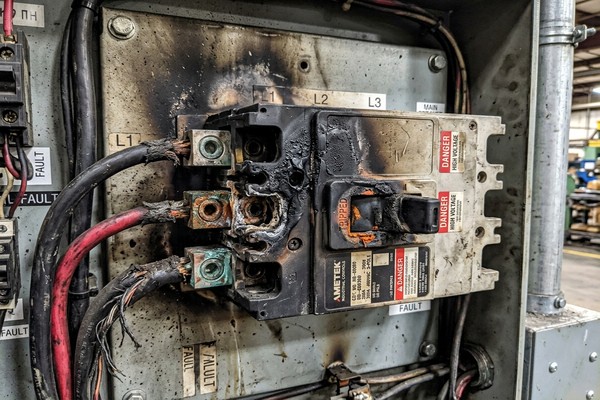
Table: Characteristics of Symmetric and Asymmetric Faults
| Fault Type | Description | Faults in which all the phases are involved and the system remains balanced. | Fault Type |
| Feature | Symmetric Faults | Asymmetric Faults |
Causes and Consequences
Electrical faults typically arise from several factors:
- Insulation degradation: Over time, electrical insulation can degrade due to aging, heat, or environmental exposure, leading to breakdown.
- Mechanical damage: Physical stress, impacts, or vibrations can damage conductors and insulation.
- Environmental stress: Moisture, extreme temperatures, corrosive elements, and lightning strikes can all trigger faults.
- Human error: Incorrect wiring, improper installation, or inadequate maintenance practices contribute significantly.
- Equipment aging: Components naturally wear out, increasing the likelihood of failure.
The consequences of these faults are severe and wide-ranging:
- Safety Hazards: Arc flashes, for instance, can cause explosions generating between 5,000-35,000°F (2,760-19,427 °C). The immense power released can seriously injure or kill anyone nearby.
- Equipment Damage: Fault currents can destroy electrical components, motors, transformers, and other expensive equipment.
- Power Outages and Downtime: Faults cut power flow, leading to system shutdowns that can last for days, incurring substantial financial losses for businesses.
- Grid Instability: Major faults can impact the surrounding power grid, potentially causing cascading failures. Statistics show that approximately 78-88% of outages arise on distribution grids, highlighting the pervasive nature of these issues.
For a deeper understanding of the various methods employed in identifying and diagnosing electrical system issues, one might consult a comprehensive Fault diagnosis review.
The Role of Industrial Measurement Equipment in Fault Diagnosis
Accurate and timely fault detection relies heavily on robust industrial measurement equipment. These tools are essential for monitoring system parameters, identifying anomalies, and pinpointing the location and nature of faults.
Traditional Industrial Measurement Equipment for Manual Inspection
Historically, and still commonly today, technicians rely on a range of manual and semi-automated tools for fault detection:
- Multimeters and Clamp Meters: These fundamental tools measure voltage, current, and resistance, helping technicians identify abnormal electrical parameters.
- Insulation Testers (Megohmmeters): Used to assess the integrity of electrical insulation, detecting degradation before it leads to a full fault.
- Manual Line Patrols and Visual Inspection: Technicians physically inspect power lines and equipment for visible signs of damage, such as frayed wires, burn marks, or damaged insulators.
- Thermal Indicators: Simple devices or paints that change color when exposed to excessive heat, indicating potential hot spots.
- Circuit Breaker Testing: Regular testing ensures that protective devices operate correctly when a fault occurs.
- Grounding System Analysis: Verifying the effectiveness of grounding systems is crucial for mitigating ground fault risks.
More sophisticated traditional methods include:
- Over-current Relays: These devices trip circuit breakers when current exceeds a preset limit, protecting equipment from short circuits and overloads.
- Differential Relays: By comparing currents entering and leaving a protected zone (e.g., a transformer), these relays can detect internal faults. While effective, their sensitivity can be around 10% for minor internal faults, meaning smaller issues might go unnoticed.
- Negative Sequence Methods: These methods analyze the asymmetrical components in currents and voltages, offering higher sensitivity, sometimes as low as 3%, for detecting minor internal faults, especially in transformers.
- A-frame Fault Finders: Primarily used for locating ground faults in buried cables, these devices apply an 8K frequency signal to the cable and use a directional arrow and decibel (dB) readings to guide technicians to the fault’s exact location.
- Time Domain Reflectometry (TDR): This technique sends a low-voltage pulse down a cable and measures the reflections to determine the distance to a fault or impedance change, crucial for assessing cable integrity.
The development and validation of these detection methods often involve rigorous testing, as outlined in principles of Requirements-based testing, which ensures the tools meet specific operational criteria. Furthermore, the foundational understanding of how systems behave under normal and abnormal conditions is often derived from Model-based fault detection approaches, which use system models to identify discrepancies. These traditional tools are vital for diagnosing issues like voltage sags, analyzing phasor analytics, monitoring current sensors, and ensuring the protection of critical components like transformers and bus bars.
Integrating AI with Industrial Measurement Equipment for Predictive Maintenance
The landscape of fault detection is rapidly evolving with the integration of artificial intelligence (AI) and machine learning (ML). These advanced computational methods are transforming traditional fault diagnosis into proactive, predictive maintenance strategies.
Automated analytics, driven by AI, can process vast amounts of data from industrial measurement equipment, identifying subtle patterns that indicate incipient faults long before they become critical. This pattern recognition capability is particularly powerful when dealing with complex electrical systems.
Artificial neural networks (ANNs) are a prime example of ML algorithms used in this domain. Their ability to learn complex relationships from data makes them potent in identifying faulty patterns and classifying faults. ANNs offer several advantages, including excellent normalization and generalization capabilities, immunity to noise, robustness, and fault tolerance. This allows them to effectively discriminate between faulty and healthy electrical power systems, even in the presence of noisy or incomplete data.
The integration of AI enables:
- Real-time Monitoring: AI algorithms can continuously analyze data streams from sensors, providing immediate alerts when anomalies are detected.
- SCADA Integration: Fault detection systems powered by AI can be seamlessly integrated with Supervisory Control and Data Acquisition (SCADA) systems, providing a centralized platform for monitoring and control.
- Predictive Maintenance: By analyzing historical data and current operating conditions, AI models can predict when and where a fault is likely to occur, allowing for scheduled maintenance and preventing unexpected downtime.
- Asset Management: AI-driven insights help optimize the lifespan of electrical assets by ensuring timely maintenance and reducing the stress caused by undetected faults.
Advanced Technologies: Ultrasound, Infrared, and AI
Beyond traditional methods, several advanced technologies offer enhanced capabilities for electrical fault detection, often providing earlier warnings and more precise diagnoses.
Ultrasound Technology
Ultrasound technology is a non-invasive method that excels at detecting electrical faults by listening for the acoustic signatures they produce. Electrical discharges, such as corona, arcing, and tracking, generate ultrasonic emissions. These emissions occur long before significant heat is generated, making ultrasound a powerful tool for early detection, often surpassing the capabilities of infrared thermography in this regard.
Ultrasound inspection can be performed on both open-access and enclosed electrical equipment, regardless of voltage. It’s particularly effective for:
- Corona: Partial discharges that occur around high-voltage conductors due to ionization of air.
- Arcing: Electrical discharges that occur between two conductors or a conductor and ground.
- Tracking: A process of progressive degradation of an insulating material by localized discharges.
By detecting these acoustic discharges, ultrasound allows maintenance teams to identify problems at their earliest stages, preventing them from escalating into catastrophic failures.
Infrared Thermography
Infrared thermography detects electrical faults by measuring and visualizing temperature differences. Electrical components that are failing or under stress often generate excessive heat, creating “hot spots.” Infrared cameras can quickly identify these thermal anomalies, which may indicate:
- Loose Connections: High resistance at a connection point leads to increased heat.
- Overloaded Circuits: Circuits carrying more current than they are designed for will overheat.
- Component Failure: Internal defects in components like transformers or circuit breakers can cause localized heating.
While infrared is excellent for detecting heat signatures, it typically identifies issues that have already progressed to a point where heat is being generated. This is why it often complements ultrasound technology, which can catch problems even earlier.
Advanced AI Algorithms
The application of AI in fault detection extends to specific, powerful algorithms:
- Support Vector Machines (SVMs): These are supervised learning models used for classification and regression analysis. In fault detection, SVMs can classify electrical system states (healthy vs. various fault types) by finding an optimal hyperplane that separates different data classes.
- Deep Learning: A subset of machine learning that uses multi-layered neural networks (deep neural networks) to learn complex patterns from data.
- LSTM Autoencoders: Long Short-Term Memory (LSTM) networks are a type of recurrent neural network particularly adept at processing sequential data, like time-series electrical measurements. An autoencoder is trained to reconstruct its input, and when presented with anomalous data (a fault), it struggles to reconstruct it accurately. The resulting “reconstruction loss” can be thresholded to detect anomalies. This approach is effective for detecting open-circuit and short-circuit faults in three-phase power systems.
- Convolutional Neural Networks (CNNs): Often used for image recognition, CNNs can also be applied to electrical fault detection by converting time-series data into image-like representations (e.g., spectrograms) and then identifying fault patterns.
- Deep Belief Networks (DBNs): These are generative graphical models composed of multiple layers of latent variables. They can learn hierarchical representations of data, useful for complex fault diagnosis.
Other Advanced Methods
- Frequency Response Analysis (FRA): This technique analyzes the electrical response of equipment (like transformers) across a range of frequencies. Changes in the frequency response (SFRA signatures) can indicate mechanical deformations or winding faults.
- Magnetic Flux Measurement: Specialized sensors, such as search coils, can measure variations in magnetic flux within electrical equipment. Anomalies in flux patterns can indicate internal faults, such as turn-to-turn faults in transformer windings, often providing high accuracy and sensitivity. Non-invasive leakage flux-based methods are also being developed, deploying sensors near the transformer core to avoid intrusive hardware.
Data Modeling and Future Trends in Fault Intelligence
The efficacy of modern electrical fault detection systems, particularly those leveraging AI and machine learning, is fundamentally dependent on high-quality data and sophisticated modeling techniques.
The Critical Role of Data
Data serves as the lifeblood for training and validating fault detection models. Large, diverse datasets are essential to enable algorithms to learn the intricate patterns associated with various fault types and distinguish them from normal operating conditions. For instance, datasets containing nearly 12,000 data points, labeled with different fault types, have been used to train and validate models.
- Data Generation: In many cases, real-world fault data is scarce or difficult to obtain safely. Therefore, simulation environments like MATLAB and Simulink are invaluable. Engineers can model complex power systems, introduce various fault conditions (e.g., line-to-ground, line-to-line, three-phase faults), and generate synthetic data representing voltages and currents under both normal and faulty conditions.
- Data Preprocessing: Before feeding data to machine learning models, it often undergoes normalization (e.g., using standard deviation) to ensure consistent scaling and improve model performance. Adding controlled Gaussian noise to training data can also enhance the model’s robustness to real-world measurement fluctuations.
- Model Training and Validation: This collected and preprocessed data is then used to train AI models, such as LSTM autoencoders. The models learn to identify “normal” behavior, and any significant deviation from this learned norm is flagged as an anomaly or fault. Validation with unseen data is crucial to ensure the model’s generalization capability.
Fault Localization
Beyond merely detecting a fault, accurately pinpointing its location is paramount for rapid repair and minimizing downtime. Advanced models can contribute significantly here:
- Phase-Independent Analysis: For three-phase systems, fault localization can involve training separate anomaly detectors for each phase. This allows for phase-specific fault identification, indicating precisely which phase (or phases) is affected. Simulink models, for example, can use a ‘For Each Subsystem’ to apply the same fault localization logic to each phase independently, processing voltage and current as two features per phase.
Future Trends and Advancements in Electrical Fault Detection
As of April 2026, the field of electrical fault detection is on the cusp of several transformative advancements:
- Grid Modernization and Distributed Sensors: The ongoing modernization of electrical grids, often termed “smart grids,” involves the deployment of an increasing number of distributed sensors. This includes smart meters, phasor measurement units (PMUs), and other intelligent electronic devices (IEDs) across the transmission and distribution networks. This enhanced observability provides unprecedented amounts of data, enabling more precise and rapid fault detection and localization.
- Advanced Meter Infrastructure (AMI): AMI is poised to play a crucial role, providing granular data from customer premises that can be leveraged for fault detection, particularly for high-impedance faults that are difficult to detect from substations.
- Fault Direction Determination: With distributed sensor networks, determining the direction of a fault (upstream or downstream) from a sensing point is critical. Advanced techniques, including traveling wave methods, which analyze the propagation of fault-induced transients, are becoming more sophisticated.
- Faster Response Times: The demand for minimal service interruption drives the need for incredibly fast fault detection and isolation. The “Total Response Time” (TRT) for critical protection functions, encompassing sensing, analytics, communication, and control actions, is being pushed to extremely low limits, sometimes requiring less than 2 cycles (approximately 33.33 milliseconds).
- Integration with Distributed Generation (DG): The increasing penetration of distributed generation (e.g., solar, wind) introduces new challenges, such as islanding (where a portion of the grid becomes isolated but continues to be energized by DG) and reverse power flow. Future fault detection systems will need to incorporate advanced islanding detection and control techniques to ensure safety and stability.
- Cyber-Physical Systems: The convergence of cyber and physical infrastructure means that fault detection systems are becoming integral parts of larger cyber-physical systems. This necessitates robust, secure, and highly interconnected fault intelligence frameworks that can not only detect physical faults but also identify and respond to cyber threats that could impact grid operation.
These trends collectively point towards a future where electrical fault detection is not just reactive but highly predictive, adaptive, and integrated, ensuring unprecedented levels of safety and reliability in our electrical infrastructure.
Frequently Asked Questions
What are the primary causes of electrical faults in industrial systems?
Electrical faults in industrial systems commonly stem from a combination of factors. These include the natural aging and degradation of insulation materials, which can break down over time due to heat, chemical exposure, or electrical stress. Mechanical stress, such as vibrations, impacts, or improper installation, can also damage conductors and connections. Environmental factors like moisture, extreme temperatures, lightning strikes, or corrosive atmospheres are significant contributors. Furthermore, human error during installation, maintenance, or operation, alongside the general wear and tear of equipment aging, frequently leads to various types of electrical faults.
How does ultrasound differ from infrared for fault detection?
Ultrasound and infrared technologies offer complementary approaches to electrical fault detection, differing primarily in what they detect and when. Infrared thermography detects heat signatures, identifying “hot spots” that indicate resistance issues, overloaded components, or failing parts that are already generating excessive heat. Ultrasound, on the other hand, detects the acoustic emissions (like corona, arcing, and tracking) produced by electrical discharges. Crucially, ultrasound can detect these discharges at their earliest stages, often before significant heat is generated. This makes ultrasound a superior method for early detection of incipient faults, while infrared is excellent for identifying more developed thermal issues.
What is the advantage of using machine learning for fault classification?
Machine learning offers significant advantages for electrical fault classification due to its ability to process and interpret complex data patterns that might be imperceptible to human operators or traditional rule-based systems. Key benefits include:
- Automated Pattern Recognition: ML algorithms can automatically learn and recognize intricate fault signatures from vast datasets, leading to highly accurate and consistent diagnoses.
- Noise Robustness: Many ML algorithms, particularly neural networks, are designed to be robust to noise in measurement data, which is common in real-world industrial environments.
- Predictive Capabilities: By analyzing trends and anomalies, ML models can predict the likelihood and type of an impending fault, enabling proactive maintenance and preventing unexpected downtime.
- High Accuracy and Speed: Once trained, ML models can classify faults in real-time with high accuracy, allowing for rapid response and mitigation strategies.
Conclusion
The journey through the complexities of electrical fault detection reveals a field constantly evolving, driven by the critical need for safety, reliability, and operational efficiency. From understanding the fundamental taxonomy of faults to deploying sophisticated industrial measurement equipment and leveraging cutting-edge AI, the methods for safeguarding electrical systems are becoming increasingly advanced.
As of April 2026, the integration of technologies like ultrasound, infrared, and advanced machine learning algorithms is transforming reactive maintenance into proactive fault intelligence. This shift not only minimizes the severe consequences of electrical failures, such as arc flash hazards and extensive downtime, but also contributes to the overall stability and resilience of our power grids. By embracing these advancements and committing to continuous improvement in detection capabilities, industries can ensure more secure, efficient, and operational facilities for the future.