
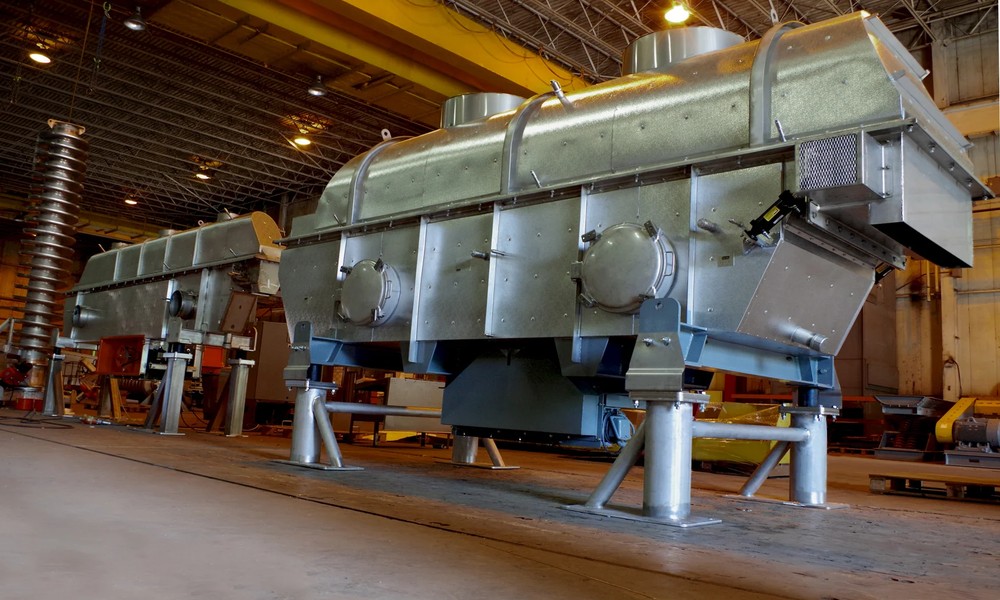
Innovations in Bulk Material Handling and Thermal ProcessingThe Role of Spiral Elevators in Modern Industrial Processing Equipment
When we first see a spiral conveyor elevator in action, it often looks counter-intuitive. Many expect materials to move down the slope, not up. Yet, these clever machines reliably lift bulk materials and products against gravity, making them vital in many industries.
In today’s production environments, moving materials vertically is a significant challenge. It demands efficient use of space and gentle handling of products. Spiral conveyor elevators offer a powerful answer to these needs. They save valuable floor space, reduce product damage, and can even do more than just convey.
This article will explain the secret behind these systems. We will break down how a spiral conveyor elevator works, from its basic principles to its main parts. We will also look at the different materials it can handle. For a closer look at the advanced engineering behind Carrier spiral elevator operation, we can see how they deliver reliable vertical transport. Finally, we will explore the many benefits of these systems, including their unique ability to heat or cool materials while moving them.
In the dynamic landscape of modern industrial processing, the efficient vertical transport of bulk materials is paramount. Spiral elevators, often referred to as spiral conveyors, represent a sophisticated solution that addresses critical operational challenges such as limited floor space, the need for continuous material flow, and the demand for gentle product handling. These systems are not merely conveyors; they are engineered solutions designed to integrate seamlessly into complex production lines, offering significant advantages over traditional vertical conveying methods.
Our approach to custom engineering ensures that each spiral elevator is tailored to the specific material behavior and process requirements of an application. Whether dealing with fine powders, granular solids, or delicate food products, the design of the helical flights, the drive system, and the overall structure are meticulously planned. This level of customization allows for optimal performance, minimizing product degradation and maximizing throughput. For example, a spiral elevator can achieve impressive heights, with some designs reaching up to 60 feet, while occupying a footprint as small as 3 square meters for capacities of 12 tons per hour. This remarkable space optimization is a key factor in their widespread adoption across diverse industries.
Compared to other vertical conveying systems, spiral elevators stand out for their efficiency and versatility. While bucket elevators move materials in discrete batches and screw conveyors are typically limited to shallower inclines, spiral elevators provide a continuous, gentle flow. This continuous motion is crucial for maintaining product integrity and ensuring a steady supply to subsequent processing stages.
Engineering Vertical Flow in Industrial Processing Equipment
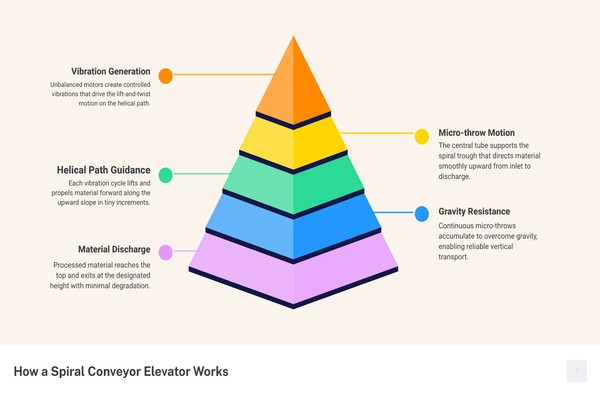
The fundamental principle behind a spiral elevator’s operation lies in its unique application of vibration technology. Unlike conventional conveyors that rely on belts, chains, or screws to push or scoop materials, vibratory spiral elevators harness a controlled ‘lift and twist’ motion. This motion is generated by carefully positioned unbalanced motors, which impart a specific frequency and amplitude of vibration to the helical trough.
As the trough vibrates, it creates a ‘micro-throw’ effect. Each vibration cycle causes the material to be momentarily lifted and simultaneously propelled forward along the upward-sloping helical path. This continuous succession of micro-throws effectively moves materials against gravity. The helical path, supported by a central tube, guides the material smoothly from the inlet at the bottom to the discharge point at the top. The incline angle at the centerline typically ranges between 4-7 degrees, optimized for efficient upward movement.
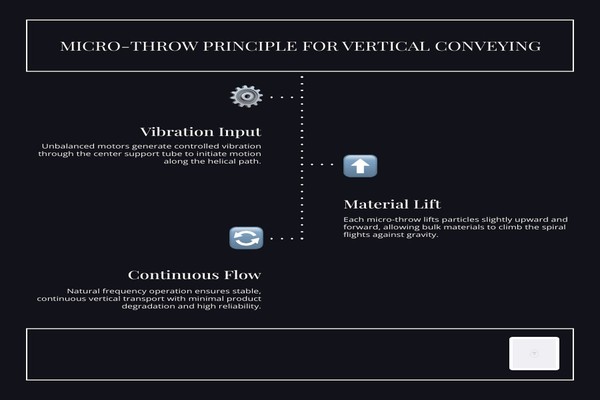
The design leverages the material’s natural frequency and kinetic properties to achieve stable and gentle transport. This ingenious mechanism allows for continuous operation, ensuring a steady flow of materials without the mechanical wear and tear associated with many other conveying methods. The precision of this vibratory action is what enables these systems to defy expectations and reliably elevate a wide array of bulk solids.
Enhancing Material Integrity and Process Reliability
One of the most significant advantages of spiral elevators is their ability to handle a broad spectrum of materials with exceptional care, enhancing material integrity and overall process reliability. Fragile materials, such as snack foods, cereals, and delicate pharmaceutical powders, benefit immensely from the gentle, controlled motion. The ‘micro-throw’ principle minimizes impact and abrasion, drastically reducing product degradation and breakage that might occur with more aggressive conveying methods.
For abrasive materials like sand, aggregates, or foundry sand, spiral elevators can be constructed with wear-resistant alloys or specialized liners to ensure long service life and consistent performance. Similarly, sticky substances, which often pose challenges for other conveyor types, can be effectively managed through the application of specialized coatings like Teflon to the helical flights, preventing buildup and blockages.
The enclosed design of many spiral elevators further contributes to process reliability. It prevents contamination from external sources, making them ideal for sanitary applications in food processing and pharmaceuticals. Stainless steel construction and crevice-free surfaces facilitate easy cleaning, meeting stringent hygiene standards. Moreover, the continuous, stable material flow inherent in their operation minimizes fluctuations in downstream processes, ensuring uniform moisture distribution and consistent particle size, which are critical for product quality and continuous duty cycles.
Thermal Processing Capabilities for Industrial Processing Equipment
Beyond their primary function of vertical material transport, spiral elevators offer a unique advantage: the ability to simultaneously perform thermal processing. This multifunctional capability can significantly streamline production lines, saving both space and energy by integrating multiple steps into a single piece of equipment.
Spiral elevators can be engineered to cool, dry, or heat materials as they travel upwards. For cooling applications, jacketed flights can be incorporated, allowing a cooling medium (like water or chilled air) to circulate, effectively reducing the material’s temperature. Alternatively, forced air systems can introduce ambient or conditioned air directly into the material bed, providing efficient heat transfer. This is particularly useful for processes where materials need to reach a specific temperature before packaging or further processing, such as cooling hot plastic pellets or castings.
Conversely, for drying or heating, heated air can be introduced, or the flights can be jacketed for steam or hot oil. This extended retention time within the helical path, combined with controlled thermal exchange, ensures uniform temperature distribution and efficient moisture removal. This is invaluable in industries like chemicals, pharmaceuticals, and food processing, where precise temperature control and moisture consistency are critical. The ability to combine conveying with thermal treatment in a compact footprint represents a significant leap in process efficiency and system reliability, especially for high-temperature applications.
Optimizing Efficiency with Integrated Thermal Systems
The integration of thermal processing capabilities within spiral elevators marks a significant advancement in bulk material handling. This synergy allows for the optimization of efficiency, reduction of energy consumption, and enhanced control over product quality. By combining vertical conveyance with processes like drying, cooling, or conditioning, industries can achieve more compact layouts and continuous, uninterrupted workflows.
Our engineering teams rigorously conduct application testing and lab testing to ensure that integrated systems perform optimally under industrial conditions. This meticulous approach guarantees predictable performance, precise moisture control, and energy efficiency tailored to specific material characteristics. For instance, the ability to cool materials while elevating them eliminates the need for separate cooling equipment and conveyors, freeing up valuable floor space and reducing overall system complexity.
Vibrating Fluid Bed Technology and Bulk Material Dryers
When advanced thermal processing is required, vibrating fluid bed technology often complements spiral elevator systems. Vibrating fluid bed dryers are renowned for their ability to achieve efficient heat exchange and uniform drying through fluidization. Materials are gently lifted and agitated by a stream of process air, creating a “fluidized” bed where each particle is exposed to the drying medium.
This technology is particularly effective for bulk material dryers, ensuring consistent moisture content and product quality. The controlled airflow and vibration prevent clumping and allow for precise adjustments to residence time, critical for sensitive materials. Furthermore, many fluid bed systems can incorporate energy recovery mechanisms, further enhancing their overall efficiency. When integrated with spiral elevators, materials can be fed directly into or discharged from a fluid bed dryer, creating a seamless, highly efficient processing line with predictable performance.
Custom Engineering for Demanding Applications
The true power of spiral elevators and integrated vibratory systems lies in their adaptability through custom engineering. Our expertise allows us to design solutions for some of the most demanding applications across various industries. For instance, in lithium processing, where precise temperature control and gentle handling of sensitive materials are crucial, custom-designed spiral elevators can provide both vertical transport and controlled thermal treatment.
In the minerals sector, these systems handle abrasive ores and aggregates, often incorporating specialized wear-resistant linings. Biomass and waste-to-energy facilities utilize robust designs for moving fibrous and often sticky materials, sometimes combined with sludge drying capabilities. Foundries benefit from solutions that cool castings or condition foundry sand while conveying, improving product quality and process efficiency. Even in complex chemical compounds and recycling operations, scalable solutions are engineered to meet unique material properties and processing requirements. This commitment to bespoke design ensures that even the most challenging material handling tasks are met with reliable, high-performing equipment.
Maintenance and Long-Term System Performance
Ensuring the long-term reliability and performance of spiral elevators is a priority, and their design inherently contributes to low maintenance requirements. With fewer moving parts compared to chain-driven or belt-driven systems, the potential for wear and tear is significantly reduced. Key components like isolation springs, which dampen vibrations and prevent transmission to the surrounding structure, are designed for durability.
Regular inspection and lubrication of drive systems, typically involving robust motors and exciters, are essential. We recommend periodic checks of components and the use of inspection ports for visual monitoring without extensive disassembly. Proper system calibration, including adjusting vibratory frequency and amplitude, ensures optimal material flow and prevents undue stress on the equipment. This proactive approach to maintenance translates into minimal downtime and extended equipment life, contributing significantly to operational reliability and a favorable return on investment for our clients.
Carrier Vibrating Equipment engineers and builds vibrating conveyors, feeders, dryers, coolers, and integrated processing systems for the most demanding bulk materials and thermal applications. As of May 2026, our engineering teams continue to focus on solving complex material handling challenges through custom-designed systems that ensure stable flow and uniform processing. Carrier Vibrating Equipment can evaluate your material and design a system engineered for your specific process. Contact our team to start a technical review.