
Innovations in Industrial Thermal Processing EquipmentEngineering Advanced Thermal Processing Solutions
In the dynamic world of industrial manufacturing, the precise transformation of raw materials into high-value products is paramount. By May 2026, industries increasingly rely on advanced thermal processing techniques to meet stringent quality demands. Among the most critical equipment in this evolution is the rotary calciner kiln, a marvel of precision engineering designed for controlled, high-temperature processing.
These specialized machines are fundamental to processes like calcination, where materials undergo chemical changes through heating without melting. Understanding their unique operation, especially their indirect heating mechanism, is essential for achieving superior product quality and efficiency in material science.
In this comprehensive guide, we will explore the intricacies of rotary calciner kilns. We will delve into their core components, differentiate them from other thermal processors, and highlight their benefits for sensitive materials. Join us as we uncover how these innovative systems deliver optimal thermal calciner solutions across a multitude of industries.
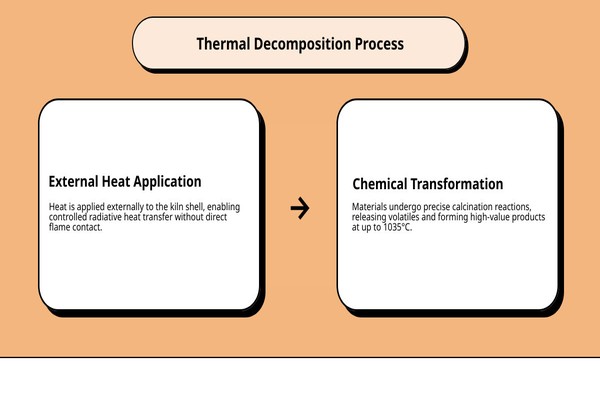
The design and engineering of rotary calciner kilns represent a sophisticated blend of material science and process engineering. At its core, the system is designed for indirect heating, a method that ensures superior thermal efficiency and precise control over the processing environment. This approach allows for the external application of heat, which then radiates through the kiln shell to the material bed. Custom design is often critical, as specific material properties and desired outcomes dictate the configuration of various components.
The primary mechanisms for heat transfer within these systems typically involve:
- Conduction: Direct transfer of thermal energy through the kiln shell to the material, and within the material bed itself.
- Convection: Heat transfer through the movement of gases within the kiln, although less dominant in indirect systems due to isolated combustion gases.
- Radiation: The primary mode of heat transfer from the heated shell surface to the material bed, ensuring uniform heating without direct flame contact.
Rotary Calciner Kiln vs Direct Fired Systems
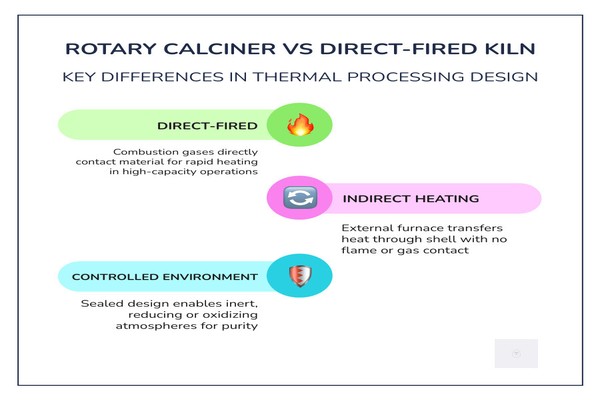
A fundamental distinction in thermal processing equipment lies between rotary calciner kilns and direct-fired rotary kilns. While both involve rotating cylindrical vessels to process materials at high temperatures, their heating mechanisms and operational philosophies diverge significantly.
A direct-fired rotary kiln, often associated with high-capacity operations, utilizes a burner at one end, allowing combustion gases to directly contact the material. This method is highly efficient for processes requiring rapid heating and where direct contact with combustion byproducts is not detrimental. However, it can introduce challenges such as potential contamination, uneven temperature distribution, and difficulty in controlling the atmosphere around sensitive materials.
In contrast, a rotary calciner kiln employs an indirect heating mechanism. Heat is generated in an external furnace, and then transferred through the kiln shell to the material inside. This means the material never comes into direct contact with flames or combustion gases. This design philosophy offers several critical advantages:
- Contamination Prevention: By isolating combustion gases, the calciner prevents the introduction of impurities from fuel byproducts into the processed material. This is crucial for high-purity applications.
- Precise Atmosphere Control: The sealed nature of the calciner allows for the introduction and maintenance of specific atmospheres-inert, reducing, or oxidizing-which are vital for chemical transformations that require oxygen exclusion or controlled reactions.
- Uniform Temperature Gradients: Indirect heating often results in more uniform temperature distribution across the material bed, leading to a more consistent product.
- Processing Sensitive Materials: This method is ideal for finely divided, dusty, or thermally sensitive materials that could be entrained in direct gas flow or degraded by direct flame impingement. For a deeper understanding of these differences, exploring resources on Rotary Calciners can be highly beneficial.
Precision Components for Thermal Processing Solutions
The robust construction of a rotary calciner kiln relies on several key components, each engineered for durability and precise function in high-temperature environments.
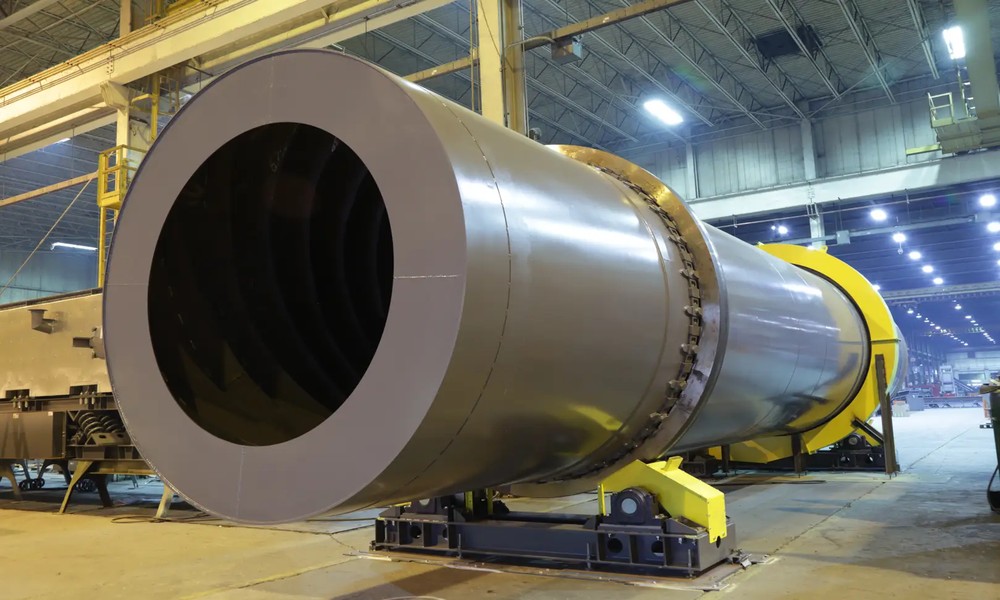
The kiln shell forms the main body, typically constructed from high-grade steel capable of withstanding extreme temperatures and stresses. For instance, while a typical rotary kiln shell can reach lengths of up to 230 meters and diameters of up to 6 meters, calciner tubes in industrial applications often reach 4 feet in diameter and 30 feet in heated length, designed for specialized, controlled processing. The internal surface of the shell is often lined with refractory materials to protect the steel from direct heat and chemical attack, ensuring longevity and thermal efficiency.
The entire assembly is supported by tyres and rollers, which allow the kiln to rotate smoothly while maintaining its precise inclination. These rollers must be meticulously aligned to prevent the kiln from “walking” off its supports, a critical aspect of operational safety and longevity. A powerful drive gear system, often incorporating variable frequency motors, controls the rotational speed, which can range from 0.5 to 5 revolutions per minute (rpm) in larger kilns, but is precisely controlled for calciners to optimize material residence time.
Internal heat exchangers may be incorporated to enhance thermal transfer efficiency within the material bed. Discharge breeching and sophisticated seal assemblies at both ends of the kiln prevent atmospheric ingress or egress, crucial for maintaining controlled processing environments. Managing thermal expansion is a significant engineering challenge, requiring careful design to accommodate the expansion and contraction of materials during heating and cooling cycles. Continuous monitoring systems, such as infrared scanners, are often employed to detect hot spots on the shell, indicating potential refractory failure. Modern systems also integrate advanced automation controls, like Rockwell Automation, for precise process management.
Material Uniformity and Atmosphere Control
Achieving precise temperature control and product uniformity is a hallmark of rotary calciner kiln operations. This is largely due to the combination of indirect heating, controlled rotation, and the ability to manage the internal atmosphere.
The continuous rotation of the kiln ensures that the material bed is constantly tumbled and mixed, promoting excellent heat transfer and minimizing temperature differentials within the material itself. This action helps to achieve plug flow conditions, where material moves through the kiln as a coherent mass, ensuring that all particles experience similar thermal histories. Factors like residence time, bed depth, and rotational speed are carefully calibrated based on the material’s properties and the desired chemical transformation.
For materials that are fine, dusty, or particularly sensitive to oxidation or contamination, rotary calciners excel. The sealed processing environment allows for the introduction of inert atmospheres (e.g., nitrogen), reducing environments (e.g., hydrogen or carbon monoxide), or precisely controlled oxidizing conditions. This capability is vital for processes like catalyst activation, where specific gas compositions are critical for surface chemistry, or for preventing unwanted reactions. This precise control over the processing environment makes rotary calciners ideal for applications where product consistency and the integrity of sensitive compounds are paramount, ensuring efficient moisture removal and chemical conversion without degradation.
Industrial Applications and Operational Safety
Rotary calciner kilns are indispensable across a broad spectrum of industries, offering robust solutions for material transformation at an industrial scale. Their ability to handle diverse materials under controlled conditions makes them vital for metallurgical processes, chemical production, and increasingly, environmental protection initiatives.
Versatile Applications for Thermal Processing Solutions
The versatility of rotary calciners is evident in their wide array of applications, encompassing fundamental thermal processes:
- Calcination: This involves heating materials to high temperatures to induce thermal decomposition, phase transitions, or to remove volatile components. Examples include the calcination of limestone to produce lime, bauxite for alumina, gypsum for plaster, and various minerals for rare earth elements.
- Thermal Desorption: Utilizing heat to remove or vaporize organic impurities or hazardous components from materials, often without altering the base material. This is critical in environmental remediation, such as the processing of contaminated soils or industrial waste.
- Drying: Efficiently removing moisture from bulk solids, particularly when precise temperature control and avoidance of direct flame contact are necessary to preserve material integrity.
Beyond these core processes, rotary calciners are instrumental in producing advanced materials for cutting-edge industries. They are used for the preparation and activation of catalysts, which are crucial for chemical reactions across numerous sectors. The production of activated carbon for filtration and purification also relies heavily on these systems. Emerging applications include the processing of lithium battery materials, where precise control over chemical composition and crystal structure is essential for battery performance. Furthermore, calciners play a significant role in hazardous waste incineration and the processing of various industrial byproducts, converting them into safer or reusable forms. For more examples of diverse applications, industry references on Rotary Calciners provide useful context.
Testing and Environmental Considerations
Before full-scale implementation, developing and optimizing processes for rotary calciners often involves extensive testing and pilot-scale options. Facilities equipped with batch and continuous pilot plants allow for the simulation of industrial conditions on a smaller scale. This enables engineers to gather critical data on material behavior, optimize temperature profiles, determine optimal residence times, and refine operational parameters. This data-driven sizing minimizes risks and ensures successful scale-up to full production.
Operating rotary calciners also necessitates careful attention to environmental and safety considerations. While indirect heating inherently reduces direct emissions from combustion gases, overall emissions control remains paramount. Modern systems often integrate technologies such as Selective Catalytic Reduction (SCR) for denitrification and bag filters for particulate matter removal, ensuring compliance with stringent environmental regulations.
Safety protocols are rigorously implemented, especially when processing hazardous waste or materials that can produce toxic fumes. This includes comprehensive monitoring, emergency shutdown systems, and robust material handling procedures. Furthermore, ongoing maintenance procedures are crucial for ensuring the safe and efficient operation of these complex machines, addressing wear and tear on components like refractory linings and drive systems. Energy efficiency is also a growing focus, with designs aiming to recover waste heat and optimize fuel consumption.
Technical Specifications and Performance Metrics
The capabilities of rotary calciner kilns are defined by a range of technical specifications and performance metrics that highlight their robust design and operational precision. Industrial rotary calciners are engineered to operate at high temperatures, often achieving maximum temperatures of up to 1035°C (approximately 1900°F) within the heated zone. Following the high-temperature processing, an integrated cooling zone can reduce the material temperature to 100°C or below, facilitating safe handling and further processing.
While traditional rotary kilns can be massive, reaching lengths of up to 230 meters (750 feet) and diameters of up to 6 meters (20 feet) with total weights, including refractories and feed, around 1,100 tonnes, rotary calciners are typically designed for more specialized applications. Their heated tubes can reach significant dimensions, such as 4 feet in diameter and 30 feet in heated length, often featuring three individually controlled heat zones to ensure precise temperature profiles along the material’s path. Modern cement plant rotary kilns operate at speeds of 4 to 5 rpm, while calciner speeds are often more finely tuned to optimize residence time and material exposure. The flexibility in fuel sources and the ability to maintain precise atmospheric conditions further underscore their advanced capabilities in industrial thermal processing.